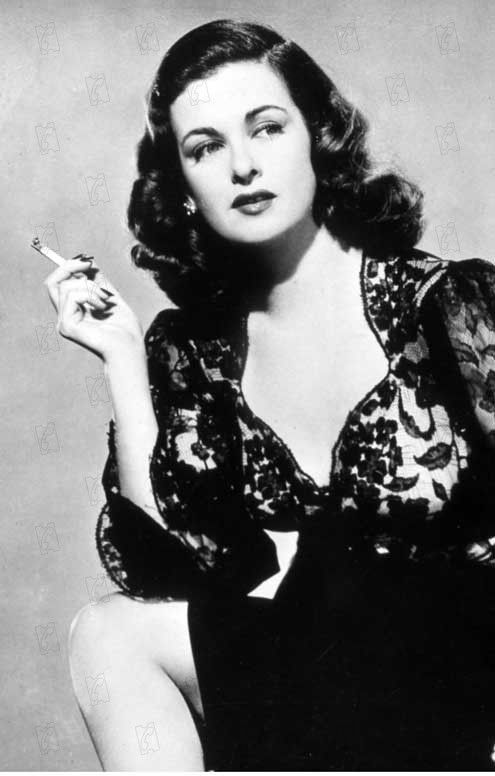
Film Noir is a term used for the distinctive Crime Dramas of the 1940's and 50's, whose roots lay in the 'Hardboiled' literature of the depression era. They were characterised by an unsentimental portrayal of crime and violence and an emphasis on sexual motive and dubious morals.
The genre is notorious for its use of low key lighting and shadow play, and black and white filming methods.
It proves, however, very hard to define the key conventions of Film Noir, as it is an incredibly diverse canon of film, with emphasis on many themes. French critics Raymond Borde and Etienne Chaumeton made this observation as early as 1955, but outlined the key features as 'oneirism, strangeness, eroticism, ambivalence and cruelty'.
The difficulty is in putting the genre into a box, or saying why it is 'Film Noir', though the private eye and femme fatale characters are classically affiliated with Film Noir, most films of the genre feature neither. Though Film Noir is thought of as an urban genre, many quintessential movies are set in suburbia. So neither setting or characterisation can be the definitive features of Film Noir. Instead many critics see it as a 'style' or a mood, its distinction is in its treatment of socially risqué themes as a norm, and the industry's arty influences.
Film Noir has roots in German expressionist film, and was partially kick-started by the emigration of many such expressionists escaping Hitler's regime.
The particular focus on femme fatales, women of 'questionable virtue', is a distinguishing quality. The distinction between the 40's and 50's periods is often to be found in how far the directors are prepared to push the illicit content, the 50's films seem to be far more liberal.
Many film noirs were produced as B movies, but have gone on to enjoy subsequent fame as classics of the style. As well as Film Noir's popularity in America, the international scene and in particular France made a huge contribution to the catalogue.
Visually, Noirs use chiaroscuro lighting, and extensively incorporate shadows into the setting. Often in scenes half of a character's face will be in darkness. Many directors make use of Dutch and low angle shots, to confer a sense of characters uneasiness, and to intimidate and disempower the audience. They also often use reflections in mirrors of characters, or through distorted glass. The direction of lighting can be used to connote certain features of the character, for example, being lit from below symbolises something ominous.
An important feature of many Film Noirs is the use of flashbacks and non-linear story lines, which ties in with oneirism and the allusion to dreams.
Film Noir has had a lasting influence in the Neo-Noir and Thriller genres, well into the modern day, such films as Taxi Driver, Heat, and Sin City provide evidence of a continuation of the Noir attitude.
Some scenes from classic Film Noirs
Out Of The Past, note the striking shadows
Joan Bennet as a femme fatale in Scarlet Street
Ascenseur Pour L'Echafaud is a classic of European Film Noir, and was scored by Miles Davis, I think meriting an appearance on my blog.
Double Indemnity is one of the most famous Film Noirs, in this scene we notice the sexually suggestive pose of the femme fatale.
The target audience of any film is the group of people who are most likely to watch it, be they middle aged women, teenage boys or elderly hermaphrodites, all groups find different things appealing. There are certain conventions which all thrillers adhere to, these are:
A crime at the core of the narrative (often murder, serial killing etc, but not necessarily).
A complex narrative structure, with false paths, clues and resolutions.
A narrative pattern of establishing enigmas which the viewer expects to be resolved.
A protagonist who is systematically dis-empowered and drawn into a complex web of intrigue by the antagonist.
Extraordinary events happening in ordinary situations.
Themes of identity.
Themes of mirroring.
Themes of voyeurism.
Protagonist with a ‘flaw’ which is exploited by the antagonist. Much like a jacobian tragedy, the 'flaw' will ultimately lead to the protagonist's downfall.
There is often a scene near the end of the film in which the protagonist is in peril. This is either resolved or in some cases of Film Noir or tragedy, the hero will die in the process of defeating the antagonist.
Mise en scene which echoes/ mirrors the protagonist’s plight.
All of these themes and conventions contribute to making a thriller, but many thrillers can be included in sub-genres, as subtle differences are often to be found between every film. This further distinction finds a more acute target audience, because some may enjoy an action thriller but be bored by a political thriller, while others may enjoy a political thriller but despise Film Noir. These sub-genres include:
Action Thriller
Crime Thriller
Film Noir
Gangster thriller
Gothic thriller
Historical thriller
Horror
Mystery
Neo-Noir
Political thriller
Psychological thriller
Romantic thriller
Sci-Fi thriller
Spy Thriller
Each Sub-genre will have it's own specific audience, some more niche than others, so it is important to know who these people are in order to plan and publicise your film so that it will reach a larger and more receptive audience.
To start with we must find the target audience for thrillers, I will do this primarily with a simple questionnaire and internet research.
Questionnaire:
Gender:
Age:
Favourite Film Genre:
Rom-Com Thriller Comedy/Spoof Western Sci-fi War
Results:
I gave the questionnaire to 20 people of various age and gender, and found that my primary target audience for Thrillers is men and women between 16 and 30, with 80% of those that chose thriller being in this age group.
Some of the younger audience may be dissuaded by an 18 certificate as they will not be allowed into cinemas to watch it, so it is important that, unless the film truly demands it, the sex and language of the film is minimised in order for it to gain a 15 certificate.
However, as our film is being made in the modern day, expectations are very different to those of such films as Psycho, which was an 18 when it came out, but now would barely merit a 12 rating. Therefore, certain things can still be included.
Recently, the success of such films as The Bourne Identity, The Sixth Sense and cult classic Donnie Darko have shown a burgeoning interest in the psychological thriller. These films are interesting because they get inside the mind of the protagonist, and usually strike up an alarming intimacy between character and audience. The study of the hero's mind makes up much of the mystery of the film, and the plot becomes usually just a device for the study to take place. They usually end with some sort of realisation or epiphany from the protagonist.
Strapped to the front of the car, as if from the engine's view. Pans following car in an extreme long shot. Views in mirror of driver, as if from passenger's point of view.
Editing -
The shots dissolve to indicate the passing of time as the journey goes on. It cuts from the car's view to see the car from far away. In the car it pans up from the windscreen to see the mirror.
Sound -
Diegetic: Sound of the engine and traffic outside.
Non-diegetic: Sound of the radio being tuned and random snatches of talking, which continue through the dissolves, suggesting it isn't diegetic.
Mise-en-scene -
The city is busy and colourful. The desert is barren and beige, there is no traffic apart from the red car which stands out.
The mountains in the background emphasise the isolation.
The man has cracking sideburns and aviator style sunglasses, placing him firmly in the 1970's. He has a shifty way of slicking back his hair which could indicate a macho-cool character.
Titles -
Come up on screen in white initially, to stand out against the dark tunnel, then yellow over the rest of the film.
They do not detract from the focus of the sequence, they are at the side.
As usual, Spielberg's credit comes up last.
The arresting aspects of this sequence are the way it is as if we are seeing it from the car's perspective, which indicates the film will focus on the car, and the way we do not know where the man is driving to, so when he reaches the desert it is as if he has abandoned the safety of the city.
Speed - Jan de Bont
Camera -
The Camera simply moves down an elevator shaft as if on top of the elevator.
In the first scene it moves following the character.
Editing -
None until the very end where it cuts without us realising, during a shot of a girder, to move forwards in the shaft.
It cuts straight to a scene in the basement.
Sound -
Non-diegetic: Thrilling music, big reverbial drums at the beginning. It then starts to sound quite like typical action movie music, and builds to a crescendo at the word Speed, after which it changes to quite fast tempo drumming, but still maintains its original instrumentation.
Mise-en-scene -
Very dark, we see some security lights in the shaft. The building is evidently very large, and everything is made from iron and concrete.
Titles -
Are in a really awful font, Big blue illegible words appearing at the right of the screen. The word Speed appears in a different font in the centre.
The actors names come up first, and the director's last.
This title sequence relates only really to the first scene and doesn't explain anything relevant to the movie, it is just a sequence over which to write the titles.
Comparison
Duel is probably the better title sequence, because it relates well to the rest of the film, and give us a sense of what to expect. It sets up the story and captures our interest from the beginning, whereas speed's beginning made me want to kill myself. The one thing which was better about Speed was the inclusion of music to capture the attention and create a mood of tension and adrenaline, however the imagery of a descending elevator was somewhat uninspired.
The sequence begins with long shots of the scenery, and pans to introduce the setting, with some extreme long shots of the arena. These shots emphasise the isolation of the area and give a sense of wariness to the viewer. There are some close-ups of the characters to show their emotions, for example fear. And in the shots of the dead bodies it is a high angle, as if from the point of view of the characters. In the shot of the children running away, the camera is on the floor to create a low angle shot, as if from the view of the dead men, and uses a focus pull to bring the football into the shot clearly.
The sequence follows the van and then its passengers, cutting between shots of them, to identify them as the subjects of the scene. There is a cut in to the notebook, which could show that it will have some significance later on. After the initial scene there is a dissolving transition to a city setting, and the title credits begin to appear.
The lighting is often dark and shadowy, a convention of most thrillers, and the cuts begin to be faster, to increase the speed of the film, as if it is building towards something happening. We cut between the female protagonist and scenes of some people removing a hard disk, which will obviously feature in the storyline.
The sound used is trying to evoke a sense of our surroundings, in the very first scene it uses lots of African instruments, which are spooky and create tension. During the scene in the city there is a greater use of violins and western instruments to accentuate a change in setting. Another piece of non-diegetic sound is the camera shutter when it goes off, which is remarkably loud and signals freeze frames, this is intended to capture attention so we look at the photographs.
The diegetic sound is that of conversation, of the speech, and of things such as gunfire and footsteps.
In the initial scene it is obvious we are in Africa, there are shots of Negro women carrying baskets on their heads, walking on very dusty roads. The run down arena is stereotypical of poor countries, and the way the men in the car are dressed it is clear that it is hot. In the city everything is grey and officious, and all the business people are wearing suits.
The titles of the film fade in and out over black before the film begins, then come up again during the scene at the UN meeting. There are large gaps between the appearance of titles, to allow us to follow what is happening in the important opening scenes.
The use of two alternate situations being juxtaposed is interesting and raises questions about how they are related, and from the very beginning, with the death of the men in the jeep, we are aware it will be about corruption. The title sequence succeeds in drawing us in, and sets the mood of the film well.
Silence of the Lambs
Silence of the lambs is a psychological thriller, which follows FBI psychologist Clarice Starling in her attempt to find a serial killer, and her various encounters with Dr. Hannibal Lecter.
To introduce the scene we see a shot of the trees to indicate we are in a lonely wood, which then pans down into the scene. The camera work in the opening sequence uses hand held techniques to make it seem like we are watching from someone's point of view, following the woman running. It is as if we are tracking her, which is immediately disturbing as we don't know what is happening.
The camera zooms back and forth, getting further away then closer, which again instils a sense that we are following her. The woman is framed in the centre of the shot to make sure she is the focus.
When we catch up to her and see her from the side, she stays on the left as if running in to the shot. The camera pans around the obstacle, as if we are overtaking and then waiting for her, but obeys the 180 degree rule.
The editing is fast, there are lots of cuts, to create tension and a sense that we are moving towards an important event. It tells us we are near Quantico in a typewritten font, like this information is being logged. This fits in with the crime thriller genre. The camera cuts in to the woman's feet and then back to a close up of her face, we see she is in obvious discomfort, and forcing herself to run, but we don't know why.
Inside the building, the lift doors close and immediately open, this signifies the passing of time, as we don't need to see her go down in the lift.
The title sequence is extremely long and is used to begin the story and establish the main character.
The Diegetic sound outside is of a general woodland feel, and we also hear the heavy breathing of the woman. Inside we hear general office noises of people talking and phones, but also see men preparing guns, which illustrates further that it is a police institute.
The Non-diegetic sound is classic thriller violins, they are high pitched and add further tension.
The Mise-en-scene of the piece is quite important, the obstacle course and the man's FBI hat introduce us to the setting, and the sign which reads 'Behavioural Science' indicates where this film is going to go.
The character of the woman is very feminist, she is strong and independent, the obstacle course could connote that she overcomes difficulties. although obviously comes across problems being in a building full of men. She smiles at the female post worker which indicates solidarity between the women there.
The credits appear in a usual order, with the star actors first, then others involved in making the film, and finally the director.
The film's opening is quite effective because the woods immediately make us think of danger, and this tension continues, but is rapidly dispersed. However, the idea of this danger does linger on after we have been introduced to it. It includes clues to the rest of the movie, in the behavioural sciences sign and the newspaper clippings on the board.
Psycho
Psycho's opening sequence shows the difference between modern and older films. It is entirely in words and images, which look very outdated to us now, as they could be easily made on a powerpoint presentation. The absence of any filmed sequence behind the titles serves to make them stand out more dramatically however. The background is black and the text comes up in white, with lines, bars and slashes in the text. The jagged cuts connote the slashing of a knife, so despite its irrelevance to the plot, it still ties in with the movie and has obviously been thought about.
The music we hear is non-diegetic, and uses very fast and high pitched violins to create tension, again they have a jagged, cutting tone, and work themselves up into a frenzy as we see Hitchcock's name. Having reached a climax the note is held and ends with a cello note, which signifies an end, and recaptures a feeling of calm for the opening scene.
The first shot pans around from above a city, which is identified as Phoenix, Arizona. The shots dissolve between each other and provide an overview of the setting. The camera then zooms in to a window where we will see the first scene. It cuts from the initial shot to another of the same window re-created in a studio, We can tell this because of the shadows and lighting. The studio set then allows the camera to move through the window into the hotel room scene.
There is nothing immediate to suggest a thriller plot, no violence or clues to later events which are common nowadays in nearly all thrillers, this provides it's own interest because it doesn't give the film away, so we want to watch on to see how the plot will unfold.
I think the slideshow title sequence is too old fashioned to work in a modern day thriller, but fits with this film as we are aware of its antiquity. It probably worked at the time because that would have been quite a modern method in 1960.
A Clockwork Orange The titles of A Clockwork Orange come up on blank red background after nearly 30 seconds, which turns to blue when it says the directors's name, and back to red for the film's title. We only see the directors name, which is unusual in any film. This sequence is very simplistic, but the colour red seems to have an importance to the mood of the film.
It then cuts to a close up of Alex's face, he wears a strange smile as he looks through the screen, and has a very intimidating presence. The camera slowly zooms out to reveal him sitting with his 'droogs' in a bar full of naked women acting as tables. This surrealist setting makes us wonder what the film is about.
All sound is Non-diegetic, the music at the very beginning is slow and ominous, and build up tension. It then cuts out as we hear Alex's voice dubbed over the scene, telling us in his strange russo-english language about what is happening, not a lot, it turns out. However, the sense of the viewer's disconnection with this dystopian society is apparent: the disconnected voice, the silent scene, the strange words and strange bars; it makes us feel wary of entering his world, and creates tension.
This initial scene cuts to a shot of a drunken old man singing, then Alex continues to narrate. We see them beat the man up with chains and bats, but he explains that the world is not as we know it, if we didn't work that out til now. The instant appearance of such 'ultraviolence' sets the tone of the film.
The Usual Suspects
The title sequence for this film is incredibly simple. We see the reflection of light in water, and very little else apart from the odd ripple, for two minutes while the credits come up in white and disappear.
After the final credit it cuts to the image of a man on a burning boat, presumably the source of the aforementioned reflection. The man tries to set fire to the boat by dropping his lighter to a line of oil, but another man urinates on it, which foils his plan of death by fire. We then see the unidentified criminal shoot the seated man, and drop his own cigarette to the oil. The scene is set at night, and the glow of the fire throws long and eery shadows across everything. The fact that we do not see the face of the killer, but the dead man (Keaton) obviously knows him, promptly sets up a mystery which must be answered by the end of the film. Thus we expect to see an action filled crime based thriller, with perhaps a twist of lime at the end.
The music is quite low key and uses moaning violins to strike a sense of fear and sadness into the audience.
The Wicker Man
The opening sequence of The Wicker Man sees a police seaplane taking off for somewhere. We see a close up of the star piloting the craft, coinciding with the appearance of his name in the titles. Throughout the sequence the credits appear in white in the bottom left, so we can still watch what is going on. Between shots of the plane it cuts to image of a landscape, which we then see the plane approaching. It is clear he is heading towards an island.
This journey to an island connotes an abandonment of the safety and security of the mainland, he is leaving normality behind.
The music is a Scottish folk song, which sets the scene as an island (the fictional Summerisle) near Scotland. The minimalist voice is quite sad and foreboding, like a lament. Then we hear another song with just guitar and voice. Diegetic sound is a minimum, just the engine noise of the plane.
As the credits finish he arrives at the island where the story will take place.
It is a very simple sequence, but suits the minimalist tone of the movie, and sets up the beginning of the story, so at least it is relevant, as it is important to know he is on an island.
This film follows the conventions of thrillers in many ways; It is a detective story for a start, criminality is a common scenario for the genre.
There are clues to the ending throughout the film, which creates a mystery for the audience, in a sense we are like the detective, being made to piece together the puzzle. However, it is not until the very end that we realise everything, the director withholds the revelation from us, and only afterwards do we fully understand the story.
The main character tells the story, so we relate to him and sympathise with him, however, it does raise the issue of reliability as we cannot be certain that the story he tells is true, and our suspicions are confirmed at the end.
The storyline is complex and spans a large section of time, intricate relations between events and characters are introduced as everything builds towards the final event.
The narrative deliberately misleads us to believe that Keaton was the enigmatic Keyser Söze, to set us up for the twist.
The musical score of the film repeatedly adds tension to important scenes, and creates character identity as certain musical phrases are associated with character's appearances.
The film's lighting style often appears natural, but many of the settings include under-lit areas where the director can emphasise the shadows and a sense of mystery.
The scene begins with a mid-long shot, which establishes the setting in the parlour. The camera then cuts to a mid-shot of the characters as they are seated, this makes us focus more on them rather than the surroundings. The camera then establishes Norman as more powerful, using a low-angle shot to intimidate the viewer. This sense of power is heightened when he leans forward into a close-up; he fills the screen and the viewer is forced to focus on him, this makes us feel tense and afraid. When marianne leaves we see a low angle shot looking up at her, as if we are looking from norman's point of view. This typically would establish her power, but this is ironic as later events show she isn't. Finally, we see a shot through the wall from norman's point of view, which has the effect of shifting our focus in the film to Norman.
The editing during the conversation is quite standard, it uses reverse shots to establish dialogue. It cuts away at certain points to the birds on the walls, which loom ominously above the characters like death omens. The raven, which appears over Marion's shoulder, is a symbol of death and foretells her fate. The end appears to watch over norman, like a mother, but also makes us wary because it is staring straight at the camera, this could link to the danger of Norman's 'mother' personality. The shadows thrown over the room connote a dark side of the story, like Norman's schizophrenia, as he has a dark, murderous side. They also create phallic imagery, which accentuates the theme of Normnan's sexual desire for Marion. The way he speaks is very closed, his body language also shows this, his hands are in his lap and he is nervous. But when he talks about his birds, he leans back and touches a bird, and rubs his crotch, he is excited by her interest and opens up a bit. On the wall over the 'peep hole' is the painting 'the rape of diana', a story of a girl who was watched by a group of men while she bathed, who then raped and killed her. this relates to the story as Norman is a voyeur, who then kills Marion. Marion's clothes are very covering, all buttoned up, suggesting she has something to hide, which probably connotes the money she stole. Norman's however are the opposite, his shirt collar is unbuttoned, this makes us feel comfortable, as though he is being open with Marion and has nothing to hide.
The diegetic sound is just that of the dialogue, we hear the characters change voices as they converse, Norman is at first shy, then angry, then shy and apologetic again; this creates tension as we find he changes moods easily, and has quite a temper. The use of non-diegetic violins and cellos creates tension aswell, when they enter the room, low violins create a sense of foreboding. When Norman is agitated, the violins build again, to underpin what he says.
A short presentation on fire and hazards procedures:
If a man is aflame, roll on his back until the offending blaze has subsided
If a man falls from a chair, morefool him
If you feel yourself about to fall from a chair, stop yourself using necessary wild gesticulation
If you see a trip hazard, use your foot to move it out of the way, or into the path of a disliked colleague
This concludes our short presentation. If you want this resource in brail or audiotape for the visually impaired, it can be procured from your local research library, or sent off for to your local MP.