Friday, April 17, 2009

Evaluation of Film Opening

Our film opening conforms to the thriller genre's conventions by our use of low key lighting in the narrative section, which gives a sense of foreboding and fear, while the use of quick cuts creates pace in the production, adding to the effect of the story-line. The idea of our opening was to begin the film immediately making the audience ask questions, so our title sequence is actually part of the film, this challenges the conventions of many films because they are usually very simple and don't have much to do with the film. In order not to detract from the piece, we used small titles in white, whereas many film use larger fonts that fill the screen. The shot angles we used were also interesting, using high and low angles to disorientate the viewer an to make it seem as if the character was being watched or surrounded,  dutch-angles to heighten this effect, and close-ups to show the emotion of the character.
The use of flashbacks is not a new idea, but I think it works well in our piece because the quick cuts make it look like the thoughts of the woman, which we wanted to achieve. The mise en scene of the piece was largely already in place, as we wanted to portray an ordinary house and ordinary woman, so we just filmed at night in one of our houses. In the flashback sequences we added sepia and other effects to make the distinction between present an flashback. For the props we used a kitchen knife, and used tomato ketchup mixed with water to make fake blood which worked quite well. In one scene we shone a bright light to create a silhouette, which had a thriller cliché quality. 
Our production piece also used a lot of non-diegetic sound, with eery music to create the mood of the film.

There aren't really any social groups represented in the piece apart from the little girl, who wears a dress and holds a doll to show she is young and female. The woman is perhaps middle class, which we can construe from her house, but she is also quite young because she wears pyjamas rather than a night-dress. Her apparent youth is partly because we used one of our group as the actress, but we wanted to portray a young mother anyway. It is not obvious from looking at her that she is a killer.

For our media piece, because it is a small and very low budget production, it would be most effective to distribute it independently, on Youtube or Myspace for example. These networking sites would allow many people to come across the video and watch it. The internet has great potential for distribution because there are such a large number of users, and there are likely to be some people there who want to find something like our film.

Our production would appeal to many different types of people; it would probably carry a 15 certificate because of it's shocking content, but there is no graphic violence or obscenity to make it an 18. Thrillers are one of the most popular genres, with many different sub-genres, and our piece largely conforms to this genre. The most likely people to target are in the age range 18 - 30, because they will enjoy the challenging aspect of the mystery in the film, and it's dark , disturbing overtones.

We used the conventions of a psychological thriller, ie. a crime, a perpetrator, and a mystery to be solved, which would attract our target audience. From the start of the piece there is a sense of urgency and action which would attract audiences, and the introduction of an enigmatic story grips the audience immediately. The idea is also a slightly different one, so this might appeal to people bored of watching the same sort of thing over and over again.

Producing this piece was the first time we had properly used the Mac editing suites, so we were able to learn as we went, utilising the effects and the timelines to make our piece exactly as we wanted it. I also used the Music software on the Macs to create our soundtrack, which added a further personal touch to the production. We were already familiar with the camera's we were using, though our shots and angles were more complex and deliberate than before. The only limitations we found were in the length of time we had to produce the piece, as there was some further tweaking of the piece which we wanted to do.

Looking back at our preliminary exercise, we have progressed and improved dramatically, and this is mostly due to further experimentation with camera angles and effects, and the use of flashbacks to break up the narrative structure. The continuity is preserved, however, in our production piece because of the way we edited it. Our use of the editing facilities was greatly aided by the increased time we spent on it, and having already produced something helped us to work faster and get better results as we were more familiar with the programme. A new factor of our production was the incorporation of titles, but this was fairly simple once we discovered how to do it.

Friday, December 26, 2008

Planning

Storyline:
The idea for our film follows the psychological journey of a woman driven to kill her daughter. The film will explore the murder in hindsight, beginning with the events prior to the murder, using flashbacks to tell the story. However, we want to instil a sense of what the story is about straight away in the opening sequence, so we have set it in the present day, years after the murder when the story is being told. The sequence will initially not make sense, the flashbacks she experiences will be in a random order, indicating confusion and fear, but eventually will assemble into a more coherent order, revealing what has happened.
It should make the audience aware of the crime, and make them wonder why.

Location:
House: bedroom, bathroom, landing, hallway and stairs, garden.
Possibly theatre for lights.
We will use my house because it has lots of space and a large garden, which will give our opening a more thrilling feel, creating a sense of isolation.
The theatre will be good for creating the lights sequences because we can control which lights are on and what colours these are.

Prop list:
Bed
Doll
Kitchen Knife
(Sink/Bath)
Fake blood
(Lighting Rig)

Order of Shots:

1) Woman lying in bed. (close up)
2) Flashback of birds pecking at the ground. (medium shot)
3) Woman getting out of bed. ( medium/ long shot)
4) Flashback of bright, blurred lights. 
5) Flashback of woman digging with hands in some soil.
6) The woman then walks onto the landing, and pauses. She is afraid.
7) Flashback of young girl laughing. (extreme close-up)
8) Pans 360 degrees around the panicking woman.
9) Flashback of more bright, blurred lights. 
10) Flashback of young girl picking up a doll, then dropping a doll.
11) Flashback of blood splattering onto a wall, or dripping on the floor. (gradually the camera fades out)
12) Fades up to the woman running down the stairs, you can hear her daughter saying "I love you mummy" in the background. 
13) Flashback of the girl holding the doll in her hands. 
14) Girl playing in the garden.
15) Quick flashback of the womans hands digging in the soil. 
16) Flashback of the girl holding the doll, and dropping it, however, this time the doll hits the floor. Sound of daughter screaming "I HATE YOU!" in the background.
17) Woman is standing in the hall. (close-up of her face)
18) Flashback of knife/shadow of knife in action.
19) Flashback of blood running down a plughole. Sound of child's laughter.
20) Bird pulling up a worm in the garden.
21) Woman turning, scared - looking for something behind her. Snippets of laughter can be heard. 

(The following will be quick cuts)
22) Child holding doll
23) Bright lights
24) Digging hands
25) Child dropping doll
26) Birds pecking at ground
27) Doll smashes on floor
28) Hands digging
29) Knife Slashing
30) Blood spatter
31) Woman stood still in garden staring straight ahead. (fade out)

Shoot Schedule:
We will film the shots of the woman walking through the house at the same time, repositioning the camera but ultimately filming in sequence, for continuity of appearance, for example, position of hair. We will also film the shots of the knife and plughole because they require artificial light.
We will film the shots of the woman's hands at a different time because it has to be daylight for that shot.
We will film all the scenes of the girl at the same time to minimise the time she has to spend on set. We will also record voice samples at the same time.
As the early bird catches the first worm, we will have to film the birds in the garden very early in the morning.
The bright lights will be filmed in the theatre at another time.

Storyboards

Storyboarding for our thriller opening:


Friday, December 12, 2008

Preliminary Excercise

Preliminary Exercise


For this continuity exercise we had to film a scenario where someone entered a room, sat down and briefly conversed with some fellow or other.
I apologise for the poor quality, it should be sorted out soon; a stern letter to 'whomsoever it may concern' should do the trick. jubbly.

Monday, December 01, 2008

The Machinist

Textual Analysis


The Machinist is a psychological thriller which follows Trevor Reznik, an insomniac industrial worker, who is alienated from his co-workers due to his strange behaviour and emaciated appearance. He is involved in an accident where a worker loses his arm, and subsequently the others turn on him. He suffers from paranoia and flashbacks, and hallucinates situations with his alter-ego Ivan, and a woman and child. He believes that the bizarre occurrences in his life, such as a series of post-it notes on the fridge, are an attempt by his co-workers to drive him insane. The only comfort he finds is in the arms of a prostitute, who becomes almost his girlfriend. Driven mad, he attempts to track down Ivan, throwing himself in front of a car to report a false hit and run incident, who was driving his own car. When he finds Ivan, he kills him, but when he attempts to throw the body into the sea, Ivan is alive on the pier near him.

Finally realising what is haunting him, Trevor remembers the hit and run incident he was involved in, when he hit a boy, identical to the child he had dreamt of, and drove away from the accident. Ivan was in fact a manifestation of his conscience, and he accompanies Trevor to the police station to confess. He is arrested and finally falls asleep in the cell, after a year without sleep.

The characters appearing in the film are:

Trevor Reznik, a paranoid delusionist who loses his job and believes his work-mates are to blame

Stevie, his prostitute lover, in whom he confides his fear

Ivan, an imagined worker from the factory, who acts as Trevor's conscience, leading him to accept his crime.

Maria, The mother of Nicholas, who Trevor imagines is a waitress at the café he visits

Nicholas, The boy Trevor ran over, and who Trevor hallucinates taking on the carnival ride

Miller, The man at the factory who lost his arm in the accident

Jackson, Jones and Reynolds,  Workers at the factory, who Trevor suspects of plotting against him.

Mrs. Shrike, The old woman who lives above Trevor

The Machinist is an example of a modern thriller, as the movie bears many characteristics of the genre. The film is about the psychological journey of the protagonist Trevor, and his paranoia and insomnia are a successful tool for the tension filled plot. His isolation intensifies the audience's connection with him, and we seem to get more inside his mind as the film goes on, experiencing his hallucinations as if real, we share Trevor's fear and paranoia, though we gradually begin to grasp the reasons he is this way. The plot is typical of a thriller as it continues to shock and raise questions, as soon as we think we have an answer, another clue to a different answer is given, for example, he goes to see Miller, and emerges more suspicious of his co-workers than before, but then he sees Ivan again, and thinks it is him instead. These sudden changes of mind characterise Trevor, he is frantic and never seems to understand anything, thus the audience become entangled in his franticness, which drives the movie forward, through Trevor's process of finding his cure. The film has been called a 'superior psychological thriller', as it is less about plot, and more about conveying a state of mind, which it does brilliantly.

Many conventions of the thriller are shown in the filming techniques. Pathetic fallacy, and the fact many scenes are shot at night, add to the tension and mysterious feeling of the movie. Often, a blue filter is used, to make the scene seem cold and dark. These scenes are interspersed with bright, glaring scenes in the sunlight, in which we find Trevor never really fitting in, as if he is better off in the dark, where he eventually retreats entirely.

The score adds to the tension, using such instruments as a theremin, to add eery, thrilling atmospheres to the scenes. It also uses classic thrilling music, which builds the suspense. 

The use of recurring imagery, such as the post it notes and the photograph, are also typical of a thriller, and help tie the plot together in examining Trevor's mind, the images must be relevant, must lead to something. The bathroom scenes, and his face in the mirror, are also often used in thrillers, to show the character's self examination. In this Trevor asks 'who are you?', as if he doesn't know himself anymore. This idea is continued as he asks who Ivan is, and who the person tormenting him is, when in the end it is himself, so he actually has his answer staring at him all along.

The Machinist received good critical acclaim and it was said it is a 'film you will not forget'.

Sunday, November 30, 2008

Film Noir

Film Noir is a term used for the distinctive Crime Dramas of the 1940's and 50's, whose roots lay in the 'Hardboiled' literature of the depression era. They were characterised by an unsentimental portrayal of crime and violence and an emphasis on sexual motive and dubious morals.
The genre is notorious for its use of low key lighting and shadow play, and black and white filming methods.
It proves, however, very hard to define the key conventions of Film Noir, as it is an incredibly diverse canon of film, with emphasis on many themes. French critics Raymond Borde and Etienne Chaumeton made this observation as early as 1955, but outlined the key features as 'oneirism, strangeness, eroticism, ambivalence and cruelty'.
The difficulty is in putting the genre into a box, or saying why it is 'Film Noir', though the private eye and femme fatale characters are classically affiliated with Film Noir, most films of the genre feature neither. Though Film Noir is thought of as an urban genre, many quintessential movies are set in suburbia. So neither setting or characterisation can be the definitive features of Film Noir. Instead many critics see it as a 'style' or a mood, its distinction is in its treatment of socially risqué themes as a norm, and the industry's arty influences.
Film Noir has roots in German expressionist film, and was partially kick-started by the emigration of many such expressionists escaping Hitler's regime.
The particular focus on femme fatales, women of 'questionable virtue', is a distinguishing quality. The distinction between the 40's and 50's periods is often to be found in how far the directors are prepared to push the illicit content, the 50's  films seem to be far more liberal.
Many film noirs were produced as B movies, but have gone on to enjoy subsequent fame as classics of the style. As well as Film Noir's popularity in America, the international scene and in particular France made a huge contribution to the catalogue.
Visually, Noirs use chiaroscuro lighting, and extensively incorporate shadows into the setting. Often in scenes half of a character's face will be in darkness. Many directors make use of Dutch and low angle shots, to confer a sense of characters uneasiness, and to intimidate and disempower the audience. They also often use reflections in mirrors of characters, or through distorted glass. The direction of lighting can be used to connote certain features of the character, for example, being lit from below symbolises something ominous.
An important feature of many Film Noirs is the use of flashbacks and non-linear story lines, which ties in with oneirism and the allusion to dreams.

Film Noir has had a lasting influence in the Neo-Noir and Thriller genres, well into the modern day, such films as Taxi Driver, Heat, and Sin City provide evidence of a continuation of the Noir attitude.


Some scenes from classic Film Noirs

Out Of The Past, note the striking shadows

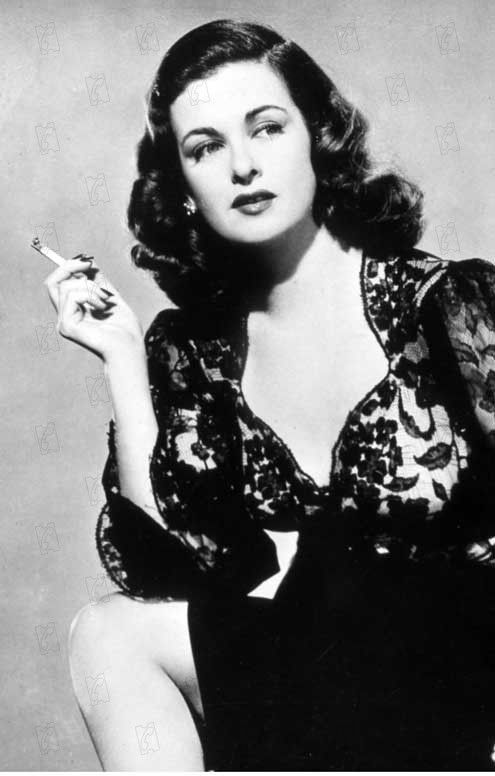
Joan Bennet as a femme fatale in Scarlet Street


Ascenseur Pour L'Echafaud is a classic of European Film Noir, and was scored by Miles Davis, I think meriting an appearance on my blog.

Double Indemnity is one of the most famous Film Noirs, in this scene we notice the sexually suggestive pose of the femme fatale.

Target Audience

The target audience of any film is the group of people who are most likely to watch it, be they middle aged women, teenage boys or elderly hermaphrodites, all groups find different things appealing.
There are certain conventions which all thrillers adhere to, these are:
  • A crime at the core of the narrative (often murder, serial killing etc, but not necessarily).
  • A complex narrative structure, with false paths, clues and resolutions.
  • A narrative pattern of establishing enigmas which the viewer expects to be resolved.
  • A protagonist who is systematically dis-empowered and drawn into a complex web of intrigue by the antagonist.
  • Extraordinary events happening in ordinary situations.
  • Themes of identity.
  • Themes of mirroring.
  • Themes of voyeurism.
  • Protagonist with a ‘flaw’ which is exploited by the antagonist. Much like a jacobian tragedy, the 'flaw' will ultimately lead to the protagonist's downfall.
  • There is often a scene near the end of the film in which the protagonist is in peril. This is either resolved or in some cases of Film Noir or tragedy, the hero will die in the process of defeating the antagonist.
  • Mise en scene which echoes/ mirrors the protagonist’s plight.
All of these themes and conventions contribute to making a thriller, but many thrillers can be included in sub-genres, as subtle differences are often to be found between every film. This further distinction finds a more acute target audience, because some may enjoy an action thriller but be bored by a political thriller, while others may enjoy a political thriller but despise Film Noir.
These sub-genres include:

Action Thriller
Crime Thriller
Film Noir

Gangster thriller

Gothic thriller

Historical thriller

Horror

Mystery

Neo-Noir

Political thriller

Psychological thriller

Romantic thriller

Sci-Fi thriller

Spy Thriller


Each Sub-genre will have it's own specific audience, some more niche than others, so it is important to know who these people are in order to plan and publicise your film so that it will reach a larger and more receptive audience.

To start with we must find the target audience for thrillers, I will do this primarily with a simple questionnaire and internet research.


Questionnaire:


Gender:


Age:


Favourite Film Genre:


Rom-Com         Thriller         Comedy/Spoof            Western            Sci-fi           War


Results:

I gave the questionnaire to 20 people of various age and gender, and found that my primary target audience for Thrillers is men and women between 16 and 30, with 80% of those that chose thriller being in this age group.

Some of the younger audience may be dissuaded by an 18 certificate as they will not be allowed into cinemas to watch it, so it is important that, unless the film truly demands it, the sex and language of the film is minimised in order for it to gain a 15 certificate.

However, as our film is being made in the modern day, expectations are very different to those of such films as Psycho, which was an 18 when it came out, but now would barely merit a 12 rating. Therefore, certain things can still be included.


Recently, the success of such films as The Bourne Identity, The Sixth Sense and cult classic Donnie Darko have shown a burgeoning interest in the psychological thriller. These films are interesting because they get inside the mind of the protagonist, and usually strike up an alarming intimacy between character and audience. The study of the hero's mind makes up much of the mystery of the film, and the plot becomes usually just a device for the study to take place. They usually end with some sort of realisation or epiphany from the protagonist.